


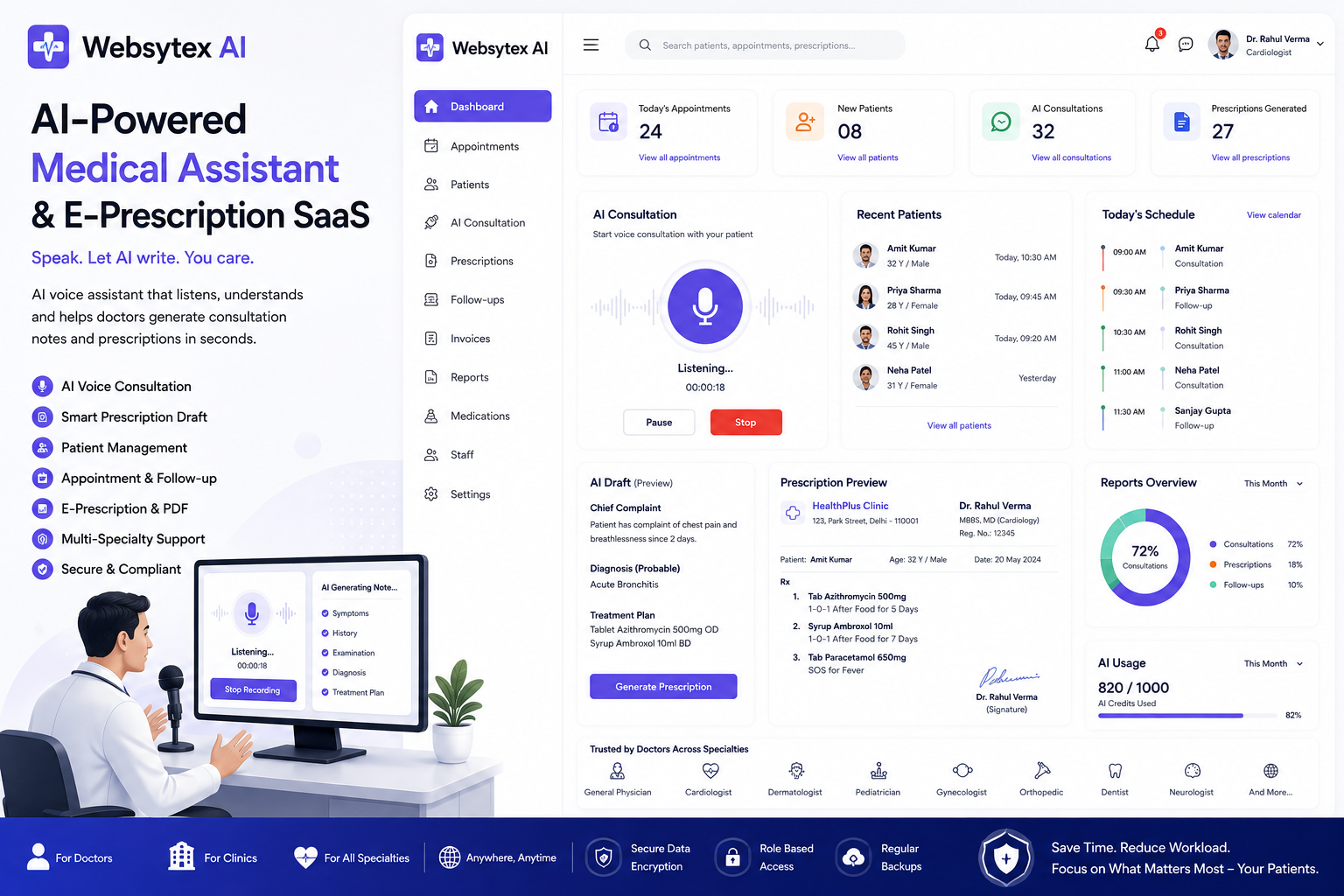
AI-Powered Medical Assistant & E-Prescription Software: Transforming Modern Healthcare
Healthcare is becoming increasingly digital, but doctors and medical professionals still spend a significant amount of time on administrative work such as documenting consultations, preparing prescriptions, reviewing patient information, managing appointments, and maintaining medical records.
Artificial Intelligence (AI) is changing this scenario by helping healthcare professionals automate repetitive documentation and improve clinical workflows.
Websytex AI is an AI-powered Medical Assistant and E-Prescription SaaS designed to help doctors, clinics, hospitals, and healthcare organizations manage everyday clinical activities more efficiently.
From AI-assisted consultation documentation to smart prescription drafting, patient management, appointment scheduling, and digital prescription generation, the platform brings multiple healthcare workflows together in one modern system.
What Is an AI-Powered Medical Assistant?
An AI-powered medical assistant is a software solution that uses Artificial Intelligence and Natural Language Processing (NLP) to assist healthcare professionals with documentation and administrative tasks.
Instead of manually typing every consultation detail, doctors can use voice-based workflows to capture relevant information and allow AI to organize the information into structured clinical notes.
The goal is not to replace doctors.
Rather, AI acts as a clinical workflow and documentation assistant, while the licensed healthcare professional remains responsible for reviewing information, making clinical decisions, and approving prescriptions.
Websytex AI follows this model by generating drafts and suggestions that require physician review and approval before a prescription is finalized.
Why Do Doctors Need AI in Clinical Workflows?
Doctors often need to manage several responsibilities simultaneously:
- Patient consultations
- Medical documentation
- Prescription preparation
- Appointment scheduling
- Patient follow-ups
- Medication information
- Reports and records
- Administrative activities
These tasks can consume valuable time that could otherwise be spent communicating with patients.
AI can help reduce repetitive documentation work and organize information more efficiently.
With an intelligent medical assistant, healthcare professionals can potentially create structured consultation notes faster, prepare prescription drafts, and manage patient information from a centralized platform.
Key Features of Websytex AI
1. AI Voice Consultation
Voice-based consultation allows doctors to interact naturally while the AI helps convert relevant conversation and clinical information into structured documentation.
This can reduce the need for extensive manual typing during or immediately after a consultation.
The system is designed to support AI-assisted consultation workflows and generate organized clinical information for physician review.
2. Smart Prescription Drafting
Preparing prescriptions manually can be repetitive, particularly in busy clinics.
Websytex AI can assist with generating prescription drafts based on the information entered or captured during a consultation.
The physician can review the generated information, make necessary changes, and approve the final prescription.
AI assists the doctor; it does not independently prescribe treatment.
3. Patient Management
A centralized patient management system can help healthcare professionals organize patient information and access relevant records when required.
Better organization can make it easier to manage returning patients, consultations, follow-ups, and clinical documentation.
4. Appointment & Follow-Up Management
Managing appointments is another important part of running a modern clinic.
An integrated healthcare platform can help doctors and clinics organize upcoming appointments and follow-up activities alongside patient information.
This creates a more connected workflow instead of relying on multiple disconnected systems.
5. E-Prescription & PDF Generation
Digital prescriptions can make prescription management more convenient for clinics and patients.
Websytex AI supports digital prescription workflows, including generating prescription documents that can be reviewed and approved by the physician.
6. Medication & Interaction Assistance
Medication-related information is an important part of prescription workflows.
The Websytex AI platform describes an interaction-checking capability that can cross-reference patient allergies and existing medications against pharmacological information to help identify potential conflicts.
Such tools should be treated as decision-support features and should not replace professional medical judgment.
7. EHR Integration
Healthcare organizations often already use Electronic Health Record (EHR) systems.
Replacing an existing system can be expensive and disruptive. For this reason, interoperability is an important consideration when implementing healthcare AI.
Websytex AI describes support for healthcare interoperability standards including HL7 and FHIR, allowing the platform to integrate with existing healthcare software where technically and operationally appropriate.
Benefits of AI-Powered Medical Software
Save Valuable Time
Automating repetitive documentation and administrative tasks can help healthcare professionals spend less time on paperwork.
Improve Workflow Efficiency
Bringing consultations, patients, prescriptions, appointments, and follow-ups into a connected platform can simplify day-to-day clinic operations.
Reduce Manual Documentation
Voice and AI-assisted documentation can reduce repetitive typing and help structure consultation information.
Better Patient Experience
A more organized workflow can allow healthcare professionals to focus more attention on patients rather than administrative tasks.
Support Digital Transformation
AI-powered software can help clinics and healthcare organizations move toward more modern, connected, and data-driven workflows.
Designed for Multiple Medical Specialties
Healthcare requirements differ from one specialty to another.
An AI medical assistant can be designed to support different clinical workflows across specialties, including:
- General Physicians
- Cardiologists
- Dermatologists
- Pediatricians
- Gynecologists
- Orthopedic Specialists
- Dentists
- Neurologists
- And other healthcare professionals
Specialty-specific configuration can help organizations adapt AI-assisted workflows to their operational requirements.
AI Does Not Replace Doctors
One of the most important considerations when implementing AI in healthcare is understanding the role of the technology.
AI should be used as an assistive technology, not as an autonomous replacement for a licensed medical professional.
Websytex AI's stated workflow requires the physician to review and approve generated prescription information before it is finalized.
The doctor remains responsible for:
- Reviewing patient information
- Confirming the diagnosis
- Evaluating treatment options
- Checking prescription details
- Making the final clinical decision
- Approving the prescription
This human-in-the-loop approach is essential for responsible use of AI in healthcare.
Security and Healthcare Data Protection
Medical information is highly sensitive, making data security an essential part of any healthcare software implementation.
Healthcare organizations should evaluate factors such as:
- Data encryption
- Secure authentication
- Access control
- Role-based permissions
- Data storage practices
- Audit trails
- Backup and recovery
- Applicable privacy regulations
- Integration security
Websytex AI describes security-focused architecture and references healthcare data protection frameworks including HIPAA and GDPR. Actual compliance requirements depend on the deployment environment, organization, location, contracts, and applicable regulations, so healthcare organizations should conduct their own compliance assessment before deployment.
How AI Can Transform a Doctor's Daily Workflow
Consider a typical consultation.
A patient arrives at a clinic. The doctor conducts the consultation, discusses symptoms and medical history, performs the necessary examination, and decides on the appropriate treatment.
Traditionally, the doctor may then spend additional time documenting the consultation and preparing a prescription.
With an AI-assisted workflow:
Step 1: The consultation information is captured.
Step 2: AI helps organize relevant information into structured notes.
Step 3: The system can assist with generating a prescription draft.
Step 4: Relevant medication and interaction information can be surfaced for review.
Step 5: The doctor reviews and modifies the draft.
Step 6: The physician approves and finalizes the prescription.
This approach can help create a smoother workflow while keeping the doctor in control of the final clinical decision.
Why Clinics and Hospitals Should Consider Healthcare AI
The healthcare industry is moving toward digital-first workflows.
Clinics and hospitals are increasingly looking for software that can help them:
- Reduce administrative workload
- Improve operational efficiency
- Digitize documentation
- Organize patient information
- Simplify prescription management
- Connect existing healthcare systems
- Improve staff productivity
- Deliver better digital experiences
AI can become an important part of this transformation when implemented responsibly and with appropriate clinical oversight.
Websytex AI: Built for the Future of Digital Healthcare
Websytex AI combines AI-assisted clinical documentation, prescription workflows, patient management, appointments, follow-ups, and healthcare software integration into a unified platform.
The solution is designed for healthcare professionals who want to modernize their clinical workflow without losing physician control over important medical decisions.
Whether you operate an individual practice, multi-doctor clinic, diagnostic center, or larger healthcare organization, AI-assisted software can become an important part of your digital transformation strategy.
Conclusion
Artificial Intelligence is changing the way healthcare organizations approach documentation, workflow management, and digital patient services.
An AI-powered Medical Assistant can help doctors reduce repetitive administrative work, organize consultation information, create prescription drafts, and manage clinical workflows more efficiently.
However, healthcare AI must always be implemented responsibly. Technology should support healthcare professionals rather than replace their expertise and clinical judgment.
Websytex AI brings AI-powered medical assistance and e-prescription capabilities together to help healthcare professionals save time, streamline workflows, and focus on what matters most — their patients.
Ready to Explore AI-Powered Healthcare Software?
Discover how Websytex AI can support your clinic or healthcare organization with intelligent medical workflows, AI-assisted documentation, and digital prescription solutions.
Websytex Digital Private Limited
Siliguri, West Bengal, India
Phone: +91 800 1000 205 | +91 800 1000 305
Email: support@websytex.com
Important Medical Disclaimer: Websytex AI is intended to assist healthcare professionals with documentation and workflow-related tasks. AI-generated information should not be considered a substitute for professional medical judgment. All diagnoses, treatment decisions, and prescriptions must be reviewed and approved by an appropriately licensed healthcare professional.
0 Comments: